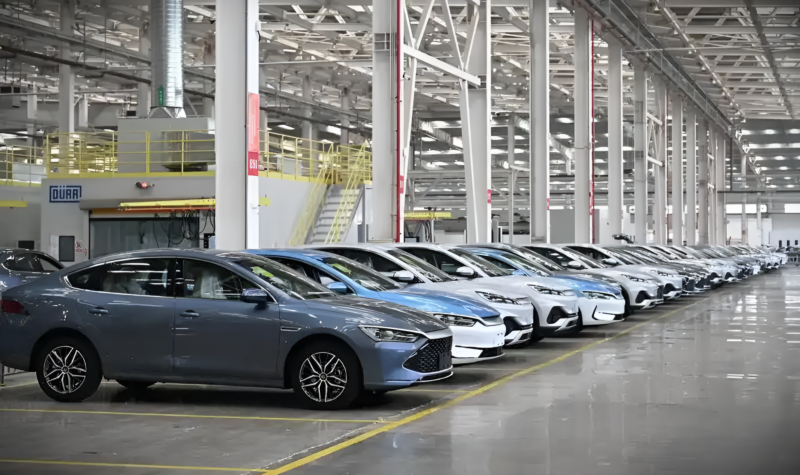
Authorities stated that, following technical upgrades, vehicles with the same battery capacity are expected to see an average increase of about 7 percent in driving range due to reduced energy consumption.
4.11 miles/kWh for the folks who still use miles.
Energy per distance is a more useful unit than distance per energy though.
I don’t know tbh. I think it’s the same as Celsius/Fahrenheit, you’re just more used to it this way and none is better than the other.
Obviously this doesn’t apply to metric/imperial, imperial makes no sense, so don’t consider me an apologist for imperial lol
Mpg is worse than its inverse gpm, because it’s not linear, and humans are really bad at comparisons of non-linear values.
Consider 3 vehicles. They get 10 mpg, 20 mpg, and 40 mpg. With these numbers, it’s obvious which is the most efficient, but it’s not easy to tell how efficient. For instance, will you get more fuel savings trading in your 10 mpg for the 20 mpg, or the 20 mpg for the 40 mpg vehicle?
Instead, if we look at those vehicles with their gpm ratings, we can quickly tell how much benefit we get from upgrading. Respectively, they are 10, 5, and 2.5 gallons per 100 miles, and it’s much easier to see that going from 10 to 20 mpg is a much bigger improvement than going from 20 to 40 mpg.
I’m confused. It’s 2x either way.
10mpg -> 20mpg is 2x increase. 10gal per 100 miles -> 5 gal per 100 miles is 2x decrease.
20mpg->40mpg is a 2x increase. 5 gal per 100 miles -> 2.5 gal per 100 miles is a 2x decrease.
It’s the same linear proportion either way florez.
So why 100 km and not some other arbitrary number?
Because most of the world already uses L/100 km currently for gas powered cars.
Huh, til
It’s a measure of efficiency- to me finding out how much work can be done per unit of energy in, is a really good way of calculating efficiency.
But equally it could be just because our first electric car uses this metric.
So in other words, this law mandates that electric vehicles must get at least 4.11 miles per kilowatt hour of efficiency? To be sold or what?
Once the standard takes effect, manufacturers will be required to carry out technical upgrades on newly produced vehicles to ensure compliance. For pure electric passenger cars with a curb weight of around two tonnes, the new requirement sets a maximum electricity consumption of 15.1 kilowatt-hours per 100 kilometers.
Additional policy measures will link the new energy consumption standard directly to financial incentives. Chinese authorities, including the Ministry of Industry and Information Technology, the Ministry of Finance, and the State Taxation Administration, have issued updated technical requirements for new energy vehicles to qualify for purchase tax exemptions in 2026 and 2027. Under these rules, pure electric passenger cars must meet the new mandatory energy consumption limits to remain eligible for tax exemptions, aligning fiscal policy with regulatory efficiency targets.
I read it too, still not sure I undetstood
Your assumption was the same as mine… they have to reach this efficiency to be sold… or possibly get a penalty if they don’t hit the target. But there was not that much detail in the article
It’s not difficult to hit that target, so I don’t think it will be a problem, but it may encourage some budget manufacturers to be a bit more careful with aero and weight decisions.
I hope this isn’t like what the EPA did in the states…
I can’t remember the exact specifics, but they did something like changed the EPA rating to be the average rating of all possible driving settings, so then Tesla removed some driving settings that weren’t as efficient (creep was one of them)
There should be a standard mode a car ships with and that’s the rating. Then if you change it, it should simply warn you that this will affect your rating.
This might be a little different given it’s about an efficiency minimum and not total distance rating… but this could kill comfort features if done incorrectly, and could be rational to kill something like creep everywhere.
And I know creep isn’t needed, but at slow speeds in things like parking lots finessing the brake is safer than managing the accelerator where a mistake triggers an accident vs simply stopping you.