• 0 Posts
  • 38 Comments
Joined 3 years ago
cake
Cake day: June 12th, 2023

help-circle

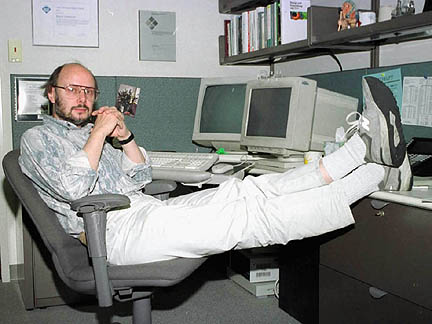
  • It was the 90s… rules were different then ! I still have my white pants deep in the closet somewhere… they haven’t seen the light of day in a while though :)

    I worked at Bell Labs back when this photo was taken - my office pretty much looked exactly like this, chair, furniture, Sun SPARCStation on the floor…

    Bjarne still rocks white pants sometimes to this day though ! And the same haircut - he really committed to the look :)



  • I do understand the sentiment. I am a bit old and have seen words and phrases shift meanings in my lifetime and feel occasional irritation due to it (although I try to care less and less about it :)

    I do find it harder to get worked up about a word that acquired additional meanings in the 14th century though - that ship has truly sailed :) Like who am I to school Mark Twain on the meaning of words.

    I also find the ability of English to use the same word with different meanings and the power of context quite interesting (the fact that individual words exist in English with 100s of distinct meanings is really quite mind blowing.)

    Ideas and concepts can sometimes be fuzzy as well with large overlaps, and insisting on too much specificity, precision and delineation in the language can be counterproductive to effective communication just as much as allowing too much flexibility can - but yeah, I guess there will always be some tension there and differences of opinion.

    Language is often messy, but always fascinating. (And btw, I never said good or bad or right or wrong - I don’t feel it’s really my place to place such judgements)


  • I am not sure you were as wrong as you think - see definitions 2 and 3 here

    Usage of words shifts and sometimes expands over time.

    More references here or here

    I would personally definitely interpret “apparently” and “plainly” differently - “apparently” to me is “the evidence so far does seem to point this way, but I am not necessarily convinced, or have strong feelings either way” vs “plainly” is “the evidence is clear, I am convinced, and so should you be” - although obviously context would matter as well and could alter this interpretation.

    Edit: even your example usage “I’ve been trying to get myself out of that habit, but even judging from my comment history, it’s apparently pretty hard” - to me the usage of “apparently” here indicates similar tension and/or contradiction, in this case between belief/intent (I am trying to stop the habit) and evidence (but my comment history shows otherwise) - it wouldn’t work quite as well with “plainly”

    It would work with “evidently” but carry more of a connotation of confirmation and shift the emphasis (I am trying to, but it’s hard as confirmed by evidence) rather than contradiction (I would like to think I am doing it, but evidence shows otherwise) - of course you might have meant it either way (or even neither) - I am just saying how it reads to me.


  • But your citation gives both statements:

    “In fact, the monkey would almost surely type every possible finite text an infinite number of times.”

    and

    “The theorem can be generalized to state that any sequence of events that has a non-zero probability of happening will almost certainly occur an infinite number of times, given an infinite amount of time or a universe that is infinite in size.”

    So when you say the number of times is “unknowable” the actual answer is “almost surely an infinite number of times” no ? Since the probability of that can be calculated as 100%. The mindfuck part is that it is still possible that no monkey at all will type a particular text, even though the probability of that is 0.

    The probability that only 2 monkeys will type the text is also still 0, same as 3 monkeys, 4 monkeys, etc. - in fact the probability of any specific finite number of monkeys only typing out the text is still 0 - only the probability of an infinite number of monkeys typing it out is 100% (the probabilities of all possible outcomes, even when infinite, have to sum up to 1 after all)

    We just know that it will almost surely happen, but that doesn’t mean it will happen an infinite amount of occurrences.

    Basically, if we know “it will almost surely happen” then we also know just as surely (p=1) that it will also happen an infinite number of times (but it might also never happen, although with p=0)


  • Ok, this is interesting, so thanks for pointing me to it. I think it’s still safe to say “almost surely an infinite number of monkeys” as opposed to “almost surely at least one”, since the probability of both cases is still 100% (can their probability even be quantitatively compared ? is one 100% more likely than another 100% in this case ?)

    The idea that something with probability of 0 can happen in an infinite set is still a bit of a mindfuck - although I understand why this is necessary (e.g. picking a random marble from an infinite set of marbles where 1 is blue and all others red for example - the probability of picking the blue marble is 0, but it is obviously still possible)


  • That’s the thing though, infinity isn’t “large” - that is the wrong way to think about it, large implies a size or bounds - infinity is boundless. An infinity can contain an infinite number of other infinities within itself.

    Mathematically, if the monkeys are generating truly random sequences of letters, then an infinite number (and not just “at least one”) of them will by definition immediately start typing out Hamlet, and the probability of that is 100% (not “almost surely” edit: I was wrong on this part, 100% here does actually mean “almost surely”, see below). At the same time, every possible finite combination of letters will begin to be typed out as well, including every possible work of literature ever written, past, present or future, and each of those will begin to be typed out each by an infinite number of other monkeys, with 100% probability.


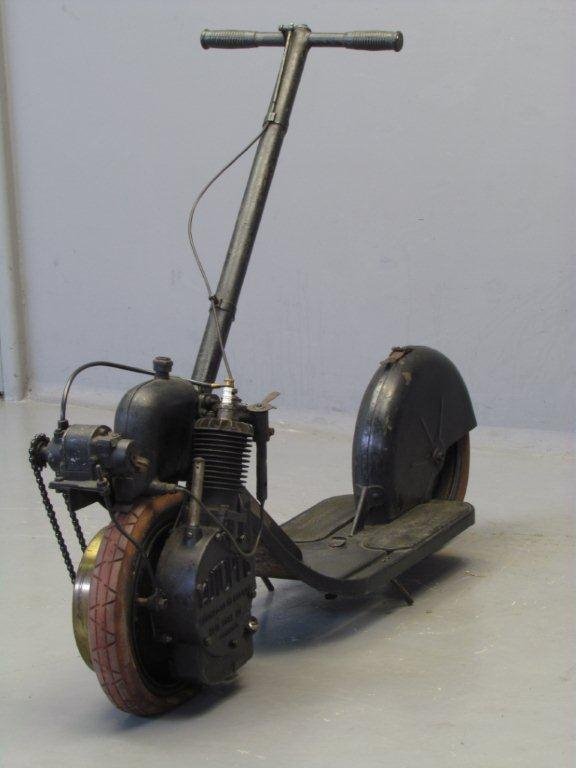
  • Pretty sure she is on a petrol one - there is a fuel tank above the front wheel, and you can see the fuel line going into the throttle body above the single piston engine. You can also see the exhaust and muffler below and behind the piston.

    Also looking into it more, I don’t think the Autoped was ever offered with an electric motor. Apparently the confusion comes from the fact that the company was bought out by the battery manufacturer Eveready, and sold as Eveready Autoped. Eveready modified the Autoped by adding a battery and ignition coil, replacing the original magneto system, but propulsion was always by means of a petrol engine.

    I don’t think the one in the photo has the battery and coil however - the coil can be seen here in front of the gas tank, but is missing in the OP photo.

    Edit: looks like the batteries and coil might have been separate - here is an article from 1917 that describes the Autoped as having a magneto ignition system (no coil) and also a battery box to operate the front and rear lights. And here is an example with an ignition coil powered from the wheel, but no battery box and no lights (which were probably optional) The one in the OP does appear to have the battery box and lights, but uses the magneto ignition, so it’s the same model as described in the article.


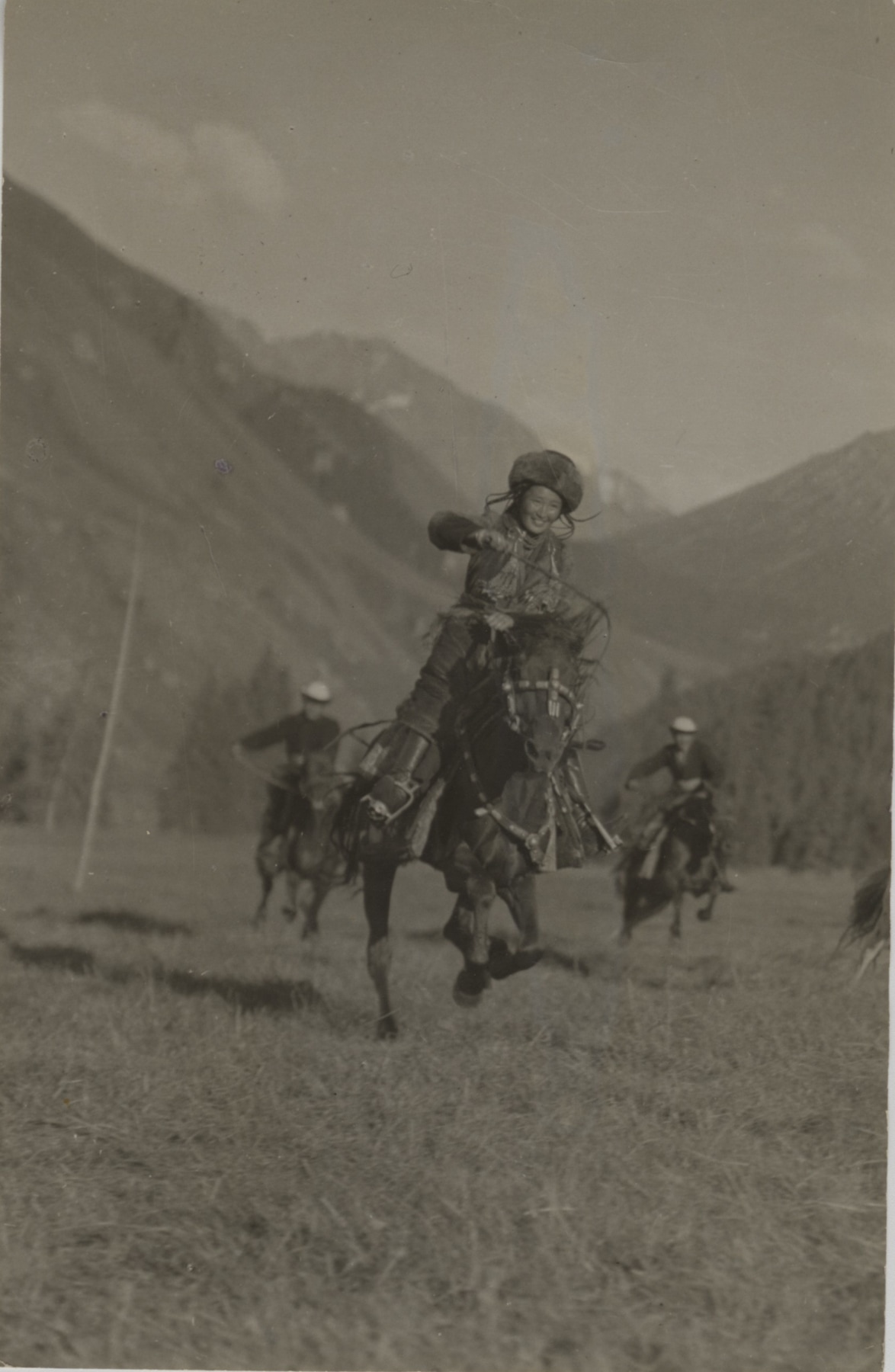
  • Fast film (you can see how grainy it is when you zoom in a little) and shooting in full bright sun = you can shoot very short exposure and freeze motion. There were already cameras in the 1930s with mechanical shutters that could do 1/500th and even 1/1000th of a second exposure, which is plenty fast for this type of shot.

    The lens looks pretty fast too - depth of field is very shallow, although part of that is also due to possible use of medium or large format - faster lens (lower f stop) and larger film both allow more light capture, and therefore faster exposure as well, but at the cost of less depth of field.

    Edit: here is a good print of the full frame - looks like ~1.50 ratio, so probably 35mm film (not medium or large format) - I can’t find a lot of information about what cameras Max Alpert used in the 30s, although he did use a 35mm Leica on at least some photos from that era. A Leica III could do 1/1000 in 1935 for example. The early Soviet cameras from the 1930s were also basically direct copies of Leicas. The frame also looks a bit underexposed, which could be due to pushing the exposure for more speed.


  • ylph@lemmy.worldtoScience Memes@mander.xyzMagic Mineral
    link
    fedilink
    English
    arrow-up
    6
    ·
    2 years ago

    They wore masks, had negative pressure ventilation suits on

    I hope those were positive pressure suits, positive pressure helps to keep dust out of the suit. Negative pressure ventilation is used to help sick people breathe easier, like the iron lung for example.